Tuesday, May 25, 2010


Wednesday, April 28, 2010
For April 2010 - The People of the Book by Geraldine Brooks

We met on April 27 at 5:30 pm at Bella Vino, the local wine bar
Wednesday, March 31, 2010


Friday, February 19, 2010
UND Writers Conference 2010

Click here for scheduled events
This year’s Writers Conference focuses on digital/electronic literature, so you have to go to these folks’ websites to read/see their work. There are no print copies for us to give you.
Space is limited, so they'll save spots for the first ten people who respond to Kim.
Monday, February 08, 2010
Sunday, December 06, 2009

Saturday, November 28, 2009
The Festival of Trees -- A RRVWP book club service project

Our book club participated in the LISTEN Center's Annual Festival of Trees this year. The trees, lights, and tree skirts are donated and all we had to provide was a theme, decorations and decorators. We decided that our tree might look cute covered in books and then the "decorations" would be dual-purposed, proving a family a wide range of books for kids of all ages and even some for the adults.
Book club members donated books and decorations and Andrea, Kristine and Carmyn got in the holiday spirit by decorating on the Tuesday before Thanksgiving. The trees were on display for a short time after that at the Columbia Mall and then they were distributed to local families in need.
Our theme was "Seasons G-READings" :) (Pam is always on hand for a good pun or two!)
Saturday, November 07, 2009

Wednesday, September 30, 2009

Sunday, August 30, 2009

Monday, July 27, 2009
For July: The Diamond Age by Neal Stephenson
 The Diamond Age Or, A Young Lady's Illustrated Primer by Neal Stephenson
Carmyn, Pam, Judy, Brian and Larry met at Pam's to discuss The Diamond Age over a bucket of chicken from the Venerable and Inscrutable Colonel Sanders.
Friday, June 26, 2009
For June: Slaughterhouse Five by Kurt Vonnegut
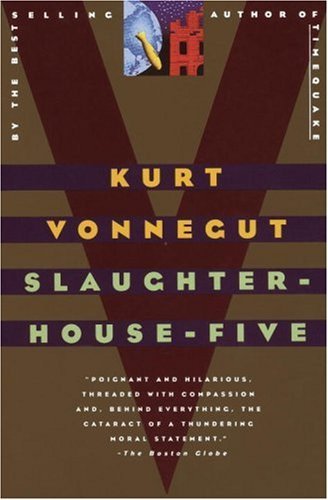
Carmyn, Pam, Brian, Andrea, Larry, and Kristine met at Pam's on June 25th for our discussion on Slaughterhouse Five by Kurt Vonnegut
Each year we usually try to read at least one of those books that many consider to be part of our literary consciousness--a classic. There are so many, and even as an English teacher, I've not read them all. It turned out THIS was a title many of us hadn't read.
The general response was mixed. I actually liked the book, though it was a bit "messed up" and demanded discussion. With the internet so handily available I immediately googled the book and read the Wikipedia page, some of the Spark Notes, and several articles about the book, including some biography pages of Kurt Vonnegut.
This was not my first exposure to Vonnegut, however. In college I read Cat's Cradle, a book which also inspired a "what the heck" as I read it. Both books have an irreverence for Christianity that might be part of why his work is so frequently getting "challenged" in schools and libraries. I, also, use the short story "Harrison Bergeron" with students.
One question that was posed at book club was "Why? Why is this book considered such a classic?"
We speculated and here are a few ideas that emerged. Slaughterhouse Five is a story within a story. It's a great example of post-modern writing. Part of the lesson that Billy Pilgrim learns from the Tralfamadorians (the aliens who abduct him and put him on display in a zoo on their planet) is demonstrated in the time travel. The structure of the novel seems to be doing something unusual and while that alone might be noteworthy, the subject matter is. We didn't completely solve this question.
It's an anti-war story told at a time when the world was rather fed up with the Vietnam War. It's a story about the bombing of Dresden and one man's response to that event. Vonnegut, himself, actually survived the bombing of Dresden and perhaps this is his way of dealing with that event.
This novel reminded me of Hemingway's short story "A Soldier's Home" which is in our American Literature textbook. In that story, Harold Krebs returns home from war and is clearly suffering from a post-traumatic stress disorder. Billy Pilgrim in Slaughterhouse Five is much the same. His apathy, "so it goes," to everything in his life from his wife, to his kids, to his job, is indicative of the sort of man he's become post-war. He only seems to get excited by Kilgore Trout, an unknown, unusual author whose work he's introduced to in the mental institution following the war. Kilgore Trout is a terrific character, the alien bit was great fun. And the war segments which actually do seem to appear in a chronological order were intriguing. Those bits made me want to know more about what happened in Dresden. They reminded me that I've read another version of that event in Jonathan Safron Foer's book Extremely Loud and Incredibly Close.
Slaughterhouse Five was worth the read, I'd recommend it even though some book club members would not. We had a rousing discussion, so there's always that!
Saturday, May 30, 2009
For May: The Book Thief by Markus Zusak
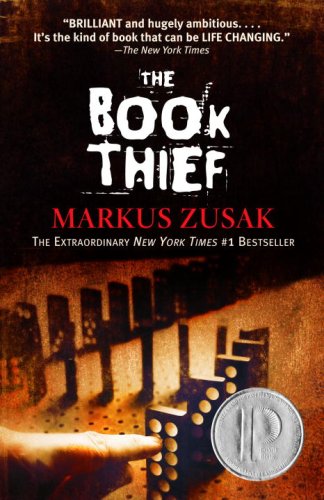
We met on May 26th at Judy's to discuss The Book Thief by Markus Zusak.
Though we didn't really intend it to be this way, our May title is another YA book and another book on WW II. We all seemed to enjoy the book. Even though the story includes a hidden Jew, it is an entirely different perspective on the WW II experience.
The Book Thief is a childhood tale, a story of family and friends and reading and books in the midst of this horrific setting--a small town on the outskirts of Munich in Germany during WW II. It's sweet and funny and tender and loving but every action is shadowed by the world in which they live. It reminded me that people grew up like this. That entire childhoods were sprouted and spent under the shadow of Hitler, with fear lurking dark all around.
The story's narrator is Death and I liked that aspect, but because of that the whole construct of the point of view, of that narrative device, the book is a bit wobbly. I found his voice and fascination with color and use of synesthesia to be poetic and lovely, but some have found Zusak's writing style to be suspect.
One twitter friend admits that while she loved it, most in her book club found it just too depressing, though I 'm not sure anyone in OUR book club felt this way. I guess I found it uplifting. I felt that Hans and Rosa Hubermann were great heroes and wonderful parents and people. I loved so many small details in this book and the big ideas too. I'd highly recommend this one.
Wednesday, April 29, 2009
For April -- A Revolutionary War Theme

We read Octavian Nothing along side the George Washington: Spymaster book and I felt the two were complementary texts. This one is a young adult novel which has a rather elevated vocabulary and explores some difficult issues. There was some discussion in our group as to whether or not we'd even call this a "YA book." It's meant to be written in the Gothic style and I think it's a very successful effort in that regard. It's quite neat, actually.
Much of the story is set in Pre-revolutionary war Boston at the home of Mr. Gitney or 03-01 as he prefers to be called (in his numerical system he's devised). There, young Octavian lives with his mother and it's not too long before we discover things are a bit unusual at the Novanglian College of Lucidity which is the official name for Gitney's "operation" in Boston. He has a team of researchers in science and all sorts of philosophical pursuits who come and go and are apparently studying Octavian as well.
The story explores the science and beliefs of the era, racial tensions, mounting tensions between the British and the Patriots, and personal freedoms and responsibilities. Most of the story is told through Octavian's eyes, but there is one section which I rather liked in which a young soldier named Evidence writes letters to his sister Fruition and we learn the events of the story that way.
A great scene in the story, which occurs just before all hell breaks loose, is the Pox Party which lends its name to the title of the book. In this scene Gitney rounds up friends and family and they infect themselves with a low dose of the small pox in an effort to become immune. One book club member commented that the scene reminded them of The Masque of the Red Death.
While not everyone in the group was finished with this book, I understood others to find it as engaging as I did.
 George Washington, Spymaster:
 How the Americans Outspied the British and Won the Revolutionary War by Thomas B. Allen
While this book had a cool premise and lots of great resources I felt it was dry, too brief, and confusing as a result. I am all about the spy world and so learning about a founding father through that lens was neat.
The book is aimed at young readers and maybe if they were already studying the Revolutionary War this would make sense to them. However, I felt like there were so many names thrown at me with little sense of who they were or how they connected. It was a lot to keep track of and it just seemed like the author could have have delved a little deeper with each one to bring the reader into the personality and character of the various players in the story.
The notes at the end of the book that corresponded with the chapters were particularly fun. I also can see how some might get a real kick out of trying to write things in Tallmadge's code which is provided in the back of the book. The author includes a lot of websites where one can view other primary source materials and I thought that was a real bonus.
Another revolutionary book that was recommended by both Larry and Brian was Paul Revere's Ride by David Hackett Fisher.
Thursday, April 09, 2009
For March: The Reader by Bernhard Schlink

When I saw the film version of The Reader I instantly wanted to discuss it with someone. The ending was mystifying to me. I wanted to know how the two characters truly "felt" toward one another. Was it actually love? Was it love for both of them? I was struck by the story and immediately added the book to my "to read" list with hopes that a written version might add in a bit more explanation or narrative element complete with a bigger glimpse into the characters thoughts as if that would help me to understand better than the intense looks and implied emotions through action in the film.
What I discovered is that I actually knew LESS at times while reading the book. It seemed like there were some extra bits in the middle of the book. For some reason I don't recall him visiting with his father about the situation with Hanna at the trial... I think in the film he sees his professor. The ending was rather spot on.
Overall, I think the film was VERY well done and Kate Winslet was a terrific Hanna. I liked the book and it provided a very good book club discussion. I liked that the focus on the Holocaust was only minimal and while that colored and shaped much of what was going on in the book there was so much more. It was about personal responsibility, choices, and guilt.
To read this book in isolation would have been less satisfying for me than reading it and then discussing it with me book group.
Friday, April 03, 2009
UND Writers Conference

at The Toasted Frog Wed. April 1, 2009
Wednesday, March 04, 2009
For Feb. -- Writers Conference Book

On March 4th we met at Judy's to discuss the various Writers Conference books we each chose to read.
Each year many of us take advantage of the opportunity to meet with an author from the conference and this year the RRVWP arranged for Greg Williamson, a poet, to be our guest author and provided copies of Errors in the Script for us to read. Still this year, we decided to each read our own picks and get together and discuss.
The 40th Annual UND Writers Conference will be held March 31-April 4, 2009, at UND.
Andrea read Downtown Owl by Chuck Klosterman and had mixed reviews but she's also read everything else he's written and enjoyed it all... She's also part done with St. Lucy's Home for Girls Raised by Wolves by Karen Russell, a short story collection.
Marci finished the whole short story collection by Russell and enjoyed the book, though she wasn't able to attend the meeting.
Judy is reading Steve Almond's Candyfreak but isn't too "sweet" on it... She also remembered she'd read Feast of Love by Charles Baxter some time ago.
Carmyn has all of these on her "to read" list and is hoping to read a few more once she is done with Sex, Drugs, and Cocoa Puffs: A low Culture Manifesto by Chuck Klosterman. She's really enjoying the essays in the Klosterman book and would happily read another. Carmyn's not read Baxter's Feast of Love, but she has seen the movie. Does that count?
UPDATE:
Following the conference I posted on my other blog about the event. For a closer look at the actual events, feel free to check out those posts on Greg Williamson Karen Russell and Steve Almond and Chuck Klosterman and Charles Baxter.
Wednesday, February 04, 2009
For January-- The Ghost in Love by Jonathan Carroll

I served a creamy tomato soup and Pam brought a yummy pecan dessert, Judy brought some homemade bread and we had all sorts of other delectables as usual! I am getting hungry just thinking about it. Too bad we couldn't figure out a way to serve, Ofi, but I am getting ahead of myself here.
What can I say? This book is surely one of the strangest books I've ever read. The book is filled with the absurd: talking dogs, the angel of death, lesbian ghosts, white earless dogs covered in faint blue tattoos, telepathic connections to strangers, traveling to memories, meeting one's fractured self.
It's a book about fate and love (less about love than I thought it would be). It's about controlling our own destinies. The book seemed to have something to say about God. There was a lot of philosophy rolling around. A lot of ideas introduced in rapid succession which added to the profoundly bizarre nature of the tale. I don't usually say this, but I think this book could have benefited from about 150 more pages just to flesh out some of those ideas, to develop the characters. This seemed to be the consensus at book club.
I had some favorite moments. One with Danielle meeting herself at all different ages sitting on picnic benches having a feast with her favorite foods. Another moment I loved was when the dog and the ghost first reveal themselves to Ben. I love that the delicious food that Ling prepares for Ben is "Ofi." And when he asks what that is she replies: "It's love and magic; it's a kid's imagination made real." She explains that his childhood love, Gina, made up that word to describe the pretend food she made him. "Nothing is more delicious than childhood love."
Pilot, the dog, was probably the best character. I just don't think it was necessary that he be the reincarnation of Ben's Italian love who was tragically killed. That sort of spoiled things for me. I mean, what are the odds... and unless that somehow matters more, WHY even have that be part of the story.
This book was an interesting read, but not an essential one. Yet, it was fun to discuss as a group.
--review by Carmyn
Wednesday, December 10, 2008
The Year of Living Biblically by A. J. Jacobs

A year ago I borrowed but didn't read Jacobs' book, The Know it All: One Man's Humble Quest to Become the Smartest Man in the World. In that book he takes his readers through his journey of reading the Encyclopedia Brittanica A-Z.
In this one, The Year of Living Biblically, his task is to follow the Bible as literally as possible. I suppose to some it might seem blasphemous, but I think his treatment of the subject matter is just fine. A bit sensational, sure, but not particularly offensive. I felt the same way when I saw Jesus Camp. I was rather surprised by some of the things he discussed. I didn't know there was a Creation museum. That floored me. Also the existence of Clean Flicks. What the heck? I guess their practice of editing films was seen as in violation of copyright so now they simply offer "clean" movies rather than try to "clean them up."
Jacobs book is fascinating. Educational. Entertaining. Laugh-out-loud funny at times. His wife is a saint and also very funny--when she deliberately sits in every chair in their home... She has spunk and is good natured and takes her crazy husband in stride. Of course I'm only half done with the book... hmmmm.....
About a week prior to reading Jacobs' book, I was directed to look at this site, which is aimed at taking a closer look at Christian culture. I was intrigued by the way the site ended up complementing my reading. I was thinking Jacobs needed to take a look at that site. Of course I haven't even gotten to the last three months of his experiment yet, when he focuses more on the New Testament.The website, is worth a browse. I started with Stephanie's first posts back in August and worked my way forward. The site might be perceived as rude. Or mocking. I suppose there is an element of the mocking involved. Still the bottom line is that so much of what I read on that site is true of my experience. I could think of examples within the Christian culture I know, on nearly every one of the 55 posts I read. Lest you think I'm pointing a finger and laughing, please realize that I know I've subscribed to many, many of these traits at one point in time. My favorite posts? #12, #19, #25, #27, #39, #45, #56 .... If I don't quit, I'll have marked them all! :)
In case you are curious as to why Stephanie is writing this blog, she addresses that in a number of the comments I've read in which she defends herself and her posts to those who are offended. Stephy says: "Christian culture doesn't have anything to do with Jesus himself. But people in Christian culture feel that doing many of these cultural things are imperative to relationship with him, and they're not. Also, Christian culture is a way to avoid true relationship and a way to "play house" if you will, little rituals and mandates not decreed by God yet they make us feel like we are closer to God. Anything can be used to avoid relationship of course, we are endlessly creative in finding ways to avoid it, because true relationship is messy and reveals things to us about ourselves that we'd rather not see. Christian culture is a very pervasive thing that isn't clearly addressed and I think it should be. So I'm writing about it."
Both the book and this blog play around with these ideas. Ideas many hold sacred. Yet, if you let yourself, you might find yourself laughing and this book was certainly educational as well as entertaining. A. J. Jacobs has a rare and unusual mind and did I mention we thought his wife was a saint?
Saturday, December 06, 2008
Fought Over Any Good Books Lately?
JOCELYN BOWIE was thrilled by the invitation to join a book group. She had just returned to her hometown, Bloomington, Ind., to take an administration job at Indiana University, and thought she had won a ticket to a top echelon. “I was hoping to network with all these women in upper-level jobs at I.U., then I found they were in the book group,” she said. “I thought, ‘Great! They’ll see how wonderful I am, and we’ll have these great conversations about books.’ ”
Ms. Bowie cannot pinpoint the precise moment when disillusion replaced delight. Maybe it was the evening she tried to persuade everyone to look beyond Oprah Winfrey’s picks, “and they all said ‘What’s wrong with Oprah?’ ” she said.
Or perhaps it was the meeting when she lobbied for literary classics like “Emma” and the rest of the group was abuzz about “The Secret Life of Bees,” a pop-lit best seller.
The last straw came when the group picked “The Da Vinci Code” and someone suggested the discussion would be enriched by delving into the author’s source material. “It was bad enough that they wanted to read ‘Da Vinci Code’ in the first place,” Ms. Bowie said, “but then they wanted to talk about it.” She quit shortly after, making up a polite excuse: “I told the organizer, ‘You’re reading fiction, and I’m reading history right now.’ ”
Yes, it’s a nice, high-minded idea to join a book group, a way to make friends and read books that might otherwise sit untouched. But what happens when you wind up hating all the literary selections — or the other members? Breaking up isn’t so hard to do when it means freedom from inane critical commentary, political maneuvering, hurt feelings, bad chick lit and even worse chardonnay.
“Who knew a book group could be such a soap opera?” said Barb Burg, senior vice president at Bantam Dell, which publishes many titles adopted by book groups. “You’d think it would just be about the book. But wherever I go, people want to talk to me about the infighting and the politics.”
One member may push for John Updike, while everyone else is set on John Grisham. One person wants to have a glass of wine and talk about the book, while everyone else wants to get drunk and talk about their spouses. “There are all these power struggles about what book gets chosen,” Ms. Burg said. Then come the complaints: “It’s too long, it’s too short, it’s not literary enough, it’s too literary ... ”
Read the complete article here.Monday, November 24, 2008
The Story of Edgar Sawtelle by David Wroblewski

Tuesday, September 23, 2008
Evidence of Things Unseen by Marianne Wiggins
 For September's book club meeting we drove to the Northland Inn in Crookston, MN where we were treated to a delicious meal by our Crookston pal, Larry! There we discussed Evidence of Things Unseen by Marianne Wiggins.
Judy suggested this book and I'm glad she did. Since she'd read this one in July, she decided to try another Wiggins book rather than reread this one. She enjoyed John Dollar, but would recommend that readers just dive in and avoid finding out too much about the book before beginning. She felt that some of the surprise and wonder was stripped away by knowing the "gist" of the book before she began.
Andrea, Judy and I all finished the book and Larry and Brian were at about the same spot in the story. We discussed Wiggins' writing style and while Judy and I enjoyed the poetic, rather "literary style" of language, Larry found Wiggins' writing style grating. I enjoyed the character descriptions and really did love the characters and the way they were portrayed in this novel-- the watery-eyed, blinking, science nerd Foss, his young wispy white-haired wife Opal, the sometimes drunken, womanizing, says-it-like-it-is, Flash. We also were impressed with the time span of the book and the historical references made to things like the Scopes Monkey Trial, WWI trench warfare, prohibition, ku klux klan, the Tennessee Valley Authority, and the Manhatten project. The story is a tender, intriguing, often heartbreaking look at a young couple's journey through these years reflecting both his desire to contribute to science and passion for things that are luminescent and their mutual desire to have a child.
Wiggins uses imagery relating to fish, to things that are illuminated, and of course there is the the frequent reference to things unseen. I really enjoyed this book and those that finished it seemed to as well. There was some comment that the ending seemed a bit "pat," or a bit too neat, but that didn't really detract from the overall experience for me. I would recommend this book.
Tuesday, August 26, 2008
The Alienist by Caleb Carr

We were split in our love of the book. Judy, for whom this was a reread, enjoyed the book, as did Pam who was pages away from finishing it. Both Carmyn and Brian who were midway through the story liked what they'd read so far, but Kristine and Andrea were less than impressed. Andrea was abandoning it, whereas Kristine read the entire thing.
It was fun to read about H.H. Holmes in the first chapter because many of us had read about him in an earlier book club pick, The Devil in the White City. Though that book was a nonfiction read and this one a fictional account with only a few mentions of historical figures. It was interesting to learn about the time period and more than once I wished I could dine at Delmonico's with the gang--the food descriptions were heavenly. The serial killer bits were pretty much the opposite. While this book didn't rock my world, it was a pleasurable read and worth the time it took.
Pam told us about another book she'd read by Caleb Carr --The Italian Secretary. That book was written as part of a commission by Sir Arthur Conan Doyle's estate for a group of current authors to write new tales. Carr's story emerged in the form of a novel and so it was published separately rather than as part of the collection. So, if you've run out of the original Sherlock Holmes' stories, you'll have to give this collection a try or check out Carr's novel.
Friday, July 25, 2008
Young Adult Novel-- Twilight by Stephenie Meyer

and we met at Kristine's for BBQs and all sorts of yummy food.
Wednesday, June 25, 2008
Author Study-- Louise Erdrich -- Reader's Choice


For June we met at the Porpoura coffee shop to discuss our Erdrich books.
Carmyn read Tracks
Judy read A Plague of Doves
Kristine started Love Medicine and then abandoned it for The Antelope Wife
Brian read two of her children's books: The Birchbark House and The Game of Silence
Sunday, May 25, 2008

Friday, March 28, 2008
UND Writer's Conference Book -- Junot Diaz
 Our featured author of the UND Writer's Conference was Junot Diaz.
Some chose to read his novel The Brief Wondrous Life of Oscar Wao and others read his short story collection Drown. We had the opportunity to meet with Diaz at The Toasted Frog.


Monday, February 25, 2008

Sunday, January 13, 2008
The Ground Beneath Her Feet by Salman Rushdie

Wednesday, November 28, 2007
Author Study---Sherman Alexie--Reader's Choice

Sherman Alexie. For November we did an author study. Readers could choose a book by this author and we discussed our choices and his writing style and subject at Aaltos Garden Cafe, a new restaurant at the Canad Inns, at 6:00 pm on Tuesday Nov. 2oth.


Monday, October 29, 2007
Three Cups of Tea by Greg Mortenson and David Oliver Relin

We met at Judy's for brunch on Saturday October 27th
Friday, September 28, 2007
Water for Elephants by Sara Gruen
 For September we read Water for Elephants by Sara Gruen.
We met at Carmyn's place on Tuesday Sept. 18th at 6:30 pm
Wednesday, August 22, 2007
Sophie's World by Jostein Gaarder

Monday, July 30, 2007
Caramelo by Sandra Cisneros

Another thing Kristine pointed out had to do with the title and its role in the story. Caramelo. The grandma had a caramelo scarf in the story and it is also the name of the book... Since she alone, completed the book, we asked her what happens with the scarf. She felt the idea wasn't developed... she said it was like Cisnero's editor told her to go back and mention the damn scarf every 75 pages or so to keep the continuity but it really wasn't any big thing and it held no epiphany and it was more than anything contrived and lacking what it could possibly have offered.
Still, it was a good discussion and the book was interesting. I'm just not sure it was one I would recommend. Try another Cisneros book first.
 Kristine's Mexican Flag Veggies
 Larry's Dos Equis Beer and Pam's Flautas
 Mexican candy to add even more authenticity.
Wednesday, June 27, 2007
Saving Fish From Drowning by Amy Tan

As we sat around the high topped table we heard consensus from the group. This wasn't the best Amy Tan any of us had read. For many of us, the story lacked sympathetic characters. For others, it was the Author's Note at the beginning they found troubling. The book hinted that the story was real.. or based on some realistic research.. because of a fictional author's note at the beginning. Kristine was intrigued enough to pause her reading and try to determine if any of these people or places existed and then was saddened to learn it was all a sort of "trick of the author." I hadn't even thought about it and simply assumed that while the story had to be fiction, I trusted the author's note to be real and that the story was BASED on some events or discoveries the author made. It wasn't until our book meeting that --I-- discovered otherwise.
We were amazed at the naivety of the Karen tribe, at the obnoxiousness of the travelers--truly playing out the role of the "ugly American" for its readers. Some readers liked Heidi by the end, so I guess there was a sympathetic connection to some extent. However, I can't say I was anything but relieved to be done with the story when it finally concluded. I love Amy Tan books but this one lacked some of the charm and magic I found in her earlier novels. In her author comments she says after her mother died that she was thinking she could no longer do mother and daughter books anymore and that her mother found a new voice in this one in the ghost narrator of Bibi Chen. I guess I did like her character for the most part but it still wasn't enough for me.
Tuesday, May 15, 2007
May's Catch Up Month

Meeting was Monday May 14
at Carmyn's Place
We each picked a book club book we'd not managed to finish during the past year and we tried to complete it for this meeting. For folks like Larry, who've completed every book, he simply needed to find a book he's been dying to read and go for it!
Here's what we've read this year:
Extremely Loud and Incredibly Close by Jonathan Safran Foer
Devil in the White City by Erik Larson
The Memory of Running by Ron McLarty
For September we each read an adolescent lit book
Wicked by Gregory Maguire
The Glass Castle by Jeannette Walls
Then we did a book swap for our January meeting
For Feb, we read Assassination Vacation by Sarah Vowell
For March, our UND Writers Conference author, Stuart Dybek's book of short stories -- Childhood and other Neighborhoods.
For April, The Memory Keeper's Daughter by Kim Edwards
Carmyn provided colorful bean dip and tortilla chips
Pam brought brats and buns in the spirit of "Catch-up"
Marci's brought veggies to dip in a lemon dill dip.
Brian brought spinach dip and crackers.
Judy brought dessert.
Larry brought beer
Kristi brought Blue Moose spicy spinach dip and chips
The Readers:
Carmyn read The Memory Keeper's Daughter by Kim Richards but didn't finish it. Not sure I will.
Pam read Wicked by Gregory Maguire and The Other Boelyn Girl by Phillippa Gregory (a book from her OTHER book club!)
Larry read Pattern Recognition by William Gibson. This wasn't originally a book club selection. It's a darker look at the future, a sci fi book with a changed approach--almost prophetic. It features a girl with a unique talent--she's a human beta-test for products, logos. She works as a consultant.
Brian read Assassination Vacation by Sara Vowell. Brian hadn't originally come to the meeting where we read this book and so this was a perfect chance to jump in and read one we KNEW he'd enjoy. We were right. And talking about it again as a group was like reminiscing a fond memory.
Marci read ?
Kristi read Memory Keeper's Daughter by Kim Edwards--didn't like it very much-- and The Glass Castle by Jeannette Walls--loved it.
Judy read NOTHING... she was surviving the end of the school year! Almost there.
We also set the books for the next three months:
For June--
Saving Fish From Drowning by Amy Tan
For July--
Caramelo by Sandra Cisneros
For August--
Sophie's World by Jostein Gaardner